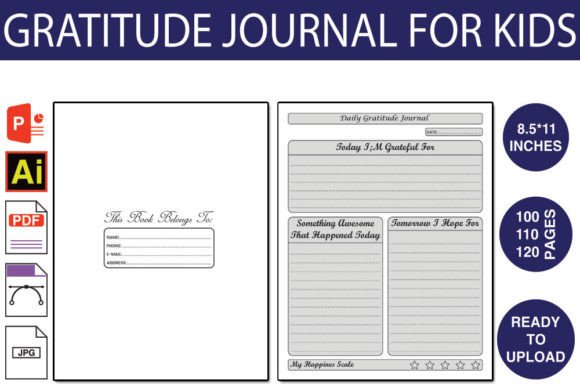
The Gratitude Journal for Kids Log Book KDP: A Practical Publishing Asset
For creators in the self-publishing space, the process of bringing a product to market involves more than just an idea. It requires tangible assets that are ready for execution. The Gratitude Journal for Kids Log Book KDP represents precisely that: a complete, customizable digital package designed for immediate integration into a KDP (Kindle Direct Publishing) workflow. This is not merely a concept or a template suggestion; it is a set of production-ready files that eliminates the foundational design work, allowing publishers to focus on customization, branding, and launch strategy.
Where This Asset Fits in the Publishing Process
Developing a journal for children involves several distinct phases: conceptualization, design, file preparation, and upload. The Gratitude Journal for Kids Log Book KDP package directly addresses the core design and file preparation stages. For an entrepreneur or creator, this means the project enters their workflow at a point of advanced readiness. Instead of starting from a blank canvas in a design software, you begin with a structured, professionally formatted interior. This shift in starting point significantly alters the project timeline, compressing the weeks often spent on layout and pagination into hours focused on personalization.
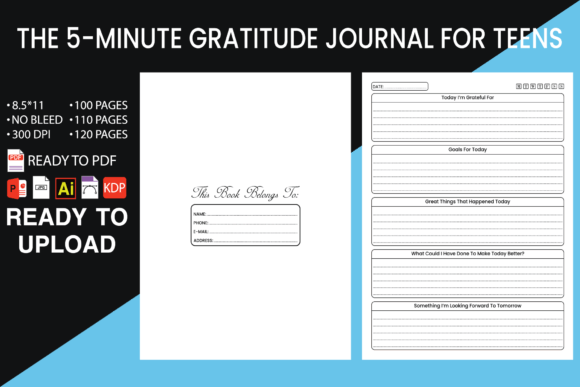
The package includes the journal in three popular page counts—100, 110, and 120 pages—providing immediate flexibility. Before even opening the source files, a publisher can decide which length best suits their target market, a decision that impacts pricing and perceived value. This upfront choice is a key strategic step in the product planning process.
Core Components and Tool Integration
The practical value of this asset lies in its multi-format offering. The inclusion of PDF, PPTX, AI, and INDD files means it is compatible with the most common design ecosystems used by professionals and hobbyists.
- The high-quality print-ready PDF is the final output file, pre-verified for KDP’s trim size requirement of 8.5” x 11” with no bleed. This file can be uploaded directly, serving as a reliable benchmark or final product.
- The PPTX (PowerPoint) file offers an accessible entry point for those less familiar with advanced graphic design. Changes to text, colors, or simple graphics can be made quickly, making it ideal for educators, bloggers, or freelancers who prioritize ease of use.
- The AI (Adobe Illustrator) and INDD (Adobe InDesign) source files are the professional-grade components. They allow for deep customization of layouts, fonts, and graphical elements. For a publisher who already uses these tools in their workflow for other projects, this journal becomes another asset in their library, editable to maintain brand consistency across their entire catalog.
This multi-format approach ensures the journal can interact smoothly with your existing toolset, whether it’s a simple office suite or a professional design subscription. There’s no need to convert files or learn new software; you use the format that matches your operational capability.
Workflow Implementation and Customization Strategies
Integrating this journal into your publishing process is straightforward. A typical efficient workflow might look like this:
- Assessment and Selection: Download the package and review the different page-count PDFs. Determine which version aligns with your vision.
- File Choice: Open the source file format you are most proficient with (e.g., PowerPoint for quick edits, InDesign for full control).
- Targeted Customization: Focus your edits on elements that add unique value. This might include changing the cover color scheme, modifying the daily gratitude prompts to suit a specific age group, adding your brand logo, or inserting occasional inspirational illustrations. The structure is already organized, so you are not building a system but enhancing one.
- Quality Control: Use the provided print-ready PDF as a reference. After customization, generate a new PDF and compare it to the original for formatting consistency, ensuring all margins and text alignments are preserved for KDP.
- Finalization and Upload: Export your final print-ready PDF and proceed to the KDP upload portal. Because the foundational specifications (trim size, no bleed) are already correct, this step is primarily about adding metadata, setting pricing, and launching.
The key to efficient implementation is to resist over-customization. The asset is designed to be high-quality at its core. Your goal is to adapt it to your market, not reinvent it. This preserves the efficiency gain the package provides.
Factors for Long-Term Use and Catalog Expansion
For publishers building a sustained business on KDP, factors like consistency and scalability are critical. The Gratitude Journal for Kids Log Book KDP, particularly through its Illustrator and InDesign source files, supports these long-term goals.
Once you customize the journal—establishing a specific font palette, a logo placement, a color theme—you can save those edited source files as your master template. This creates a standardized brand asset. Future journals (for example, a gratitude journal for teens or a different themed log book) can be developed from this same master, ensuring visual and structural consistency across your product line. This turns a single purchase into a reusable framework, improving organization and efficiency for subsequent projects.
Furthermore, the availability of three interior lengths allows for testing and iteration. You might launch the 100-page version initially, then use feedback to develop a more comprehensive 120-page edition as a premium offering. The source files enable this iterative development without restarting the design process from zero.
Usability for Diverse Audiences
The utility of this package extends beyond seasoned publishers.
- Educators and Childcare Professionals: They can quickly customize the journal using the PowerPoint file to include prompts relevant to their classroom environment, print copies locally, and use it as a practical activity tool, bypassing commercial publishing entirely.
- Freelancers and Graphic Designers: A designer hired to create a journal for a client can use these source files as a starting point, drastically reducing the client's cost and the project's turnaround time. The designer works within a proven layout, focusing their effort on unique client requests.
- Parents and Hobbyists: Even individuals with minimal design experience can use the straightforward PowerPoint file to create a personalized journal for their own children, making the asset a tool for personal projects as well as commercial ones.
This broad usability underscores the package's role as a practical implementation tool. It serves different user goals—commercial publishing, professional service delivery, and direct personal use—by providing the same robust foundation adapted through different software pathways.
Outcomes and Integration into a Broader Strategy
Ultimately, the Gratitude Journal for Kids Log Book KDP is an asset that converts planning into action. It fits into a broader creator strategy that values speed to market, professional quality, and adaptable resources. By handling the intricate details of interior layout and file specification, it allows the user to allocate their time and creativity to areas that truly differentiate their product: marketing, brand building, and audience engagement.
The decision to utilize such a package is a practical one in a content creation workflow. It is the equivalent of selecting a well-constructed foundation before building a house. You are not starting with raw materials; you are starting with a structured, reliable base that you can then finish according to your own vision. For anyone operating in the realm of digital publishing, productivity, or creative business, this represents a sensible method for achieving a polished outcome with controlled effort and resource allocation.