Exploring Maze Activity Books for Kids as a KDP Publishing Resource
For creators looking to publish on platforms like Amazon’s Kindle Direct Publishing (KDP), activity books represent a consistently popular category. The Maze Activity for Kids KDP Template is a specific resource designed to streamline the process of creating a professionally formatted maze book. Understanding its structure, applications, and how it fits within the broader landscape of KDP tools is crucial for anyone evaluating this path.
What Is the Maze Activity for Kids KDP Template?
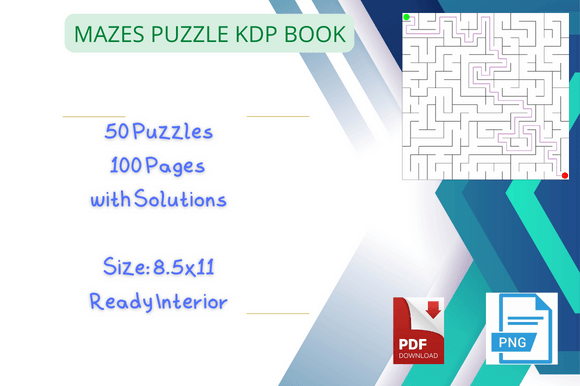
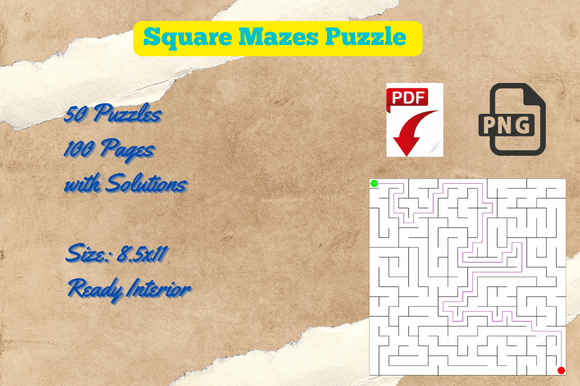
This template is a digital product bundle intended for self-publishing authors and designers. It provides the core components for a complete maze activity book, structured to meet common KDP specifications. The central offering is a set of 50 distinct square mazes, each presented on its own page with a corresponding solution page. This results in 100 pages of primary content. The template typically includes additional pages such as a “This book belongs to” front page and a copyright page, bringing the total file to 100 pages ready for upload.
The technical specifications are tailored to KDP’s paperback formatting requirements: a dimension of 8.5 x 11 inches (a standard US letter size often used for children’s activity books), and it is provided with both bleed and no-bleed versions. The files are delivered as editable PDFs and PNGs, which is a key feature. The “high-quality fully editable” aspect means the user can modify elements, add branding, or adjust layouts without needing to create the mazes or page framework from scratch.
Distinct Characteristics and Core Features
The Maze Activity for Kids KDP Template distinguishes itself from generic ideas or completely bespoke design by offering a balanced midpoint. It is not simply a collection of maze images; it is a pre-structured book layout. The inclusion of solutions is a practical consideration that adds value for the end-user—the child or parent using the physical book—and is a thoughtful detail that completes the product.
The provision of both PDF and PNG files addresses different workflow needs. The PDFs likely offer a layered or editable format for global adjustments in software like Adobe Acrobat or Illustrator, while the individual PNGs of each maze and solution allow for easy extraction or use in other design projects. Having “bleed” and “no bleed” files caters to different interior design preferences and KDP submission requirements, giving the publisher a choice based on their comfort with trim margins.
How It Compares to Other Development Approaches
When considering how to produce a maze activity book for KDP, creators generally weigh three main approaches: full custom design, using a pre-made template (like this one), or employing automated generation tools or software.
Full Custom Design involves creating every maze and page layout uniquely. This offers maximum creative control and originality. The tradeoff is significant time, design skill requirement, and potentially higher cost if outsourcing. The Maze Activity for Kids KDP Template bypasses the most labor-intensive part—generating 50 varied mazes and their solutions—while still allowing for customization of covers, introductory pages, and overall branding.
Automated Generation through software or online tools can create mazes quickly, but the output often lacks cohesive book formatting. The user would then need to compile images into a properly formatted PDF, create solution pages, and ensure page count and dimensions meet KDP standards. The template provides this compilation and formatting pre-done, saving a layer of administrative design work.
Compared to other pre-made templates, the specifics matter. A template offering 50 mazes on a 100-page, 8.5×11 inch framework is geared towards a substantial single volume. Some alternatives might offer fewer mazes, different puzzle types (like crossword or sudoku), or different page dimensions (such as 6×9 inches). The choice hinges on the envisioned final product’s length, physical feel, and target age group; larger pages can be beneficial for younger children.
Evaluating Strengths and Practical Tradeoffs
The primary strength of the Maze Activity for Kids KDP Template is efficiency. It reduces the time from concept to upload-ready file dramatically. For an individual with moderate graphic design skills, it allows focus on marketing, cover design, and branding rather than puzzle generation. The assured page count and structure also remove uncertainty about meeting KDP’s technical guidelines.
However, tradeoffs exist. Using a template means the core maze designs are fixed. While editable, the fundamental puzzles are pre-determined. This limits uniqueness; another publisher using the same template could, in theory, produce a book with identical interior mazes. Therefore, a publisher’s value addition must come from superior cover design, additional content (like coloring elements or stories interspersed), or effective marketing. The mazes themselves are a commodity.
The template’s best-fit situation is for a publisher who wants to enter the maze book market quickly without investing in custom puzzle design, or for a designer testing a niche with a lower initial investment. It is also suitable for those who may wish to use the 50 mazes as a component within a larger, hybrid activity book by integrating the PNG files into a broader layout.
When This Template Is the Right Choice
The Maze Activity for Kids KDP Template may be the optimal resource under several realistic scenarios. If your goal is to publish a straightforward, classic maze book with a professional interior layout, and your priority is speed to market, this template serves that purpose well. It is also a strong choice if your design capabilities are stronger in areas like typography, illustration, and cover art, but weaker in puzzle generation or complex page layout for print.
Furthermore, for publishers planning a series, this template could provide a consistent interior structure for multiple volumes, with changes primarily made to the cover and introductory pages to differentiate each book.
When Another Option Might Be Necessary
Consider alternative paths if your project requires specific, thematic mazes (e.g., all space-themed shapes, or mazes that form letters of the alphabet). The generic square mazes in the template may not suffice. If brand identity demands completely original puzzles to stand out in a crowded market, full custom design becomes more compelling.
Also, if the standard 8.5×11 inch size does not align with your vision—perhaps you want a smaller, travel-friendly book or a larger “big book” format—then a template with fixed dimensions becomes a limitation. Similarly, if your book concept requires integrating mazes with other activity types on the same page (e.g., a maze alongside a riddle), the pre-formatted one-maze-per-page structure would require significant alteration, potentially negating the efficiency gain.
Decision Factors for Prospective Users
Making an informed decision about using the Maze Activity for Kids KDP Template involves weighing several practical factors:
- Skill & Time Balance: Assess your own design proficiency and available time. The template trades off some creative control for considerable time savings.
- Market Differentiation: Research existing maze books on KDP. Can you compete effectively with a book using common maze structures, or does your niche require more unique puzzles?
- File Format Needs: Confirm that the provided editable PDF and PNG formats are compatible with your design software (e.g., Adobe products, Affinity Designer, Canva Pro). “Fully editable” can vary in practice.
- Page Count Strategy: The 100-page total is a specific product length. Consider if this aligns with your pricing strategy and customer expectations for a children’s activity book.
Ultimately, the Maze Activity for Kids KDP Template is a tool that shifts the workload from creation to curation and customization. It enables a viable publishing project by providing a ready-made interior, allowing the publisher to concentrate on the elements that often truly differentiate a book in the marketplace: its cover, title, presentation, and marketing. For many, this represents a sensible and pragmatic approach to entering the KDP activity book space.