Evaluating a Personal Expense Tracker Log Book for KDP Publishing
For independent publishers and content creators, the practical utility of a product often defines its market potential. A well-designed Personal Expense Tracker Log Book represents more than a simple notebook; it is a structured tool aimed at a common financial management need. The version discussed here comes packaged as a complete KDP-ready asset, including source files for customization, which shifts the evaluation from merely assessing a consumer product to analyzing a publishing resource.
Core Specifications and Immediate Utility
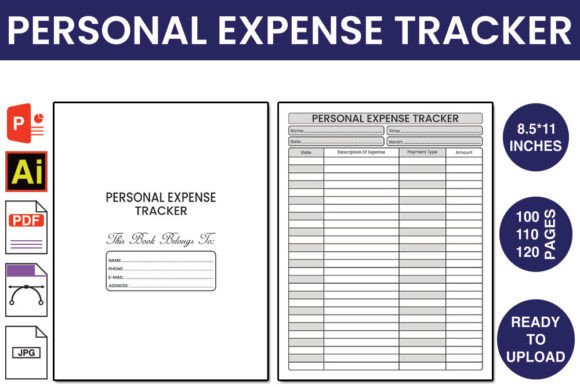
The package centers on a log book formatted for the standard US 8.5" x 11" trim size. It offers three interior page counts: 100, 110, and 120 pages, providing slight variations for users who prefer a more extensive ledger or a concise one. Notably, the files are provided with no bleed, which is a specification tailored for straightforward interior printing on platforms like Amazon KDP where bleed is often not required for basic interiors. The primary deliverable is a high-quality, print-ready PDF, ensuring the product is immediately uploadable for sale.
The true distinguishing feature, however, lies in the included source files: PPTX (PowerPoint), AI (Illustrator), and INDD (InDesign). This suite addresses a broad range of publisher technical skills. PowerPoint files are accessible to most users, Illustrator files serve vector-based editing, and InDesign files offer professional layout control. This multi-format approach significantly increases the asset's flexibility.
Analyzing the Value of Source File Access
In publishing, particularly in the niche of low-content books and practical journals, customization is a key competitive strategy. A generic expense tracker may sell, but a version tailored to a specific audience—say, travelers, small business owners, or college students—can often perform better. Owning the source files for a Personal Expense Tracker Log Book allows a publisher to modify layouts, change fonts, adjust color schemes, or even add branded introductory pages without starting from a blank slate.
The professional observation here is that this reduces both time investment and design skill barriers. A marketer with basic PowerPoint knowledge can implement simple changes. A more experienced designer can use the Illustrator or InDesign files to produce entirely derivative works. The reliability of starting from a clean, print-ready base file also minimizes formatting errors that often plague self-made templates.
Practical Considerations for Real-World Use
How might this log book perform in actual use? Its effectiveness hinges on its interior design clarity. A useful expense log requires intuitive sections for date, description, category, income, and expense amounts. The provided PDF should demonstrate a logical layout that guides the user naturally from entry to entry, with considerations for monthly summaries or categorization totals. The long-term value for the end-user—the person who buys the printed book—depends on this functional design.
For the publisher, the real-world use involves the workflow from download to upload. Having all files in one package streamlines this process. One can first upload the PDF to KDP to establish the listing, then later use the source files to create variations, testing different page counts or themed versions without purchasing separate templates.
Identifying the Primary Beneficiaries
This resource is not aimed at the general public seeking a single expense notebook. Its design as a KDP-ready package with source files targets a specific creator audience.
- KDP Publishers and Aspiring Authors: Individuals already active on Amazon's platform who want to expand their catalog with a practical, evergreen product.
- Freelancers and Digital Marketers: Those who sell digital products or templates online can repurpose the source files to create their own branded offerings on other marketplaces.
- Educators and Coaches: Financial literacy coaches or business educators might customize the log book for their clients or courses, adding specific instructions or branded elements.
- Small Business Owners: They could use the InDesign files to create a custom expense log tailored to their business expense categories, for internal use or as a client gift.
- Serious Hobbyists in Publishing: Individuals learning about self-publishing gain a complete, real-world example of a ready-to-sell product and its technical components.
Strengths and Potential Limitations
The clear strengths of this Personal Expense Tracker Log Book package are its completeness and format flexibility. It provides a tangible product and the means to adapt it. The inclusion of multiple source file types is a thoughtful touch that accommodates different software preferences and skill levels. The provision of three page counts adds minor versatility without complicating the core offering.
Potential limitations exist, as with any template product. The ultimate market success of any customized version still depends on the publisher's marketing efforts and niche selection. The interior design quality of the base PDF is a critical variable not seen in the specification list; its usability must be assessed upon receipt. Furthermore, while the source files offer customization, they require the corresponding software. A user without access to Adobe Illustrator or InDesign would primarily rely on the PowerPoint file, which may have limitations in detailed graphic alteration.
Final Assessment for Your Needs
Whether this Personal Expense Tracker Log Book KDP package fits your goals depends on your position in the publishing ecosystem. If you are looking for a single, ready-to-use expense log for personal use, this is likely more than you need. If, however, you are a creator aiming to publish on KDP or sell digital templates, this package offers a practical foundation.
It effectively lowers the barrier to entering the practical journal market. By providing the structural elements of a functional log book and the tools to modify them, it enables you to focus on customization and marketing rather than initial design and formatting. Before committing, a prudent step would be to verify the exact layout and design of the base PDF to ensure it meets a standard of clarity and practicality that would satisfy end-users. If it does, this resource can serve as a reliable and flexible asset in a publisher's toolkit.