Unleash Creativity: The Practical Power of the Lined Notebook with Poodle KDP Interior
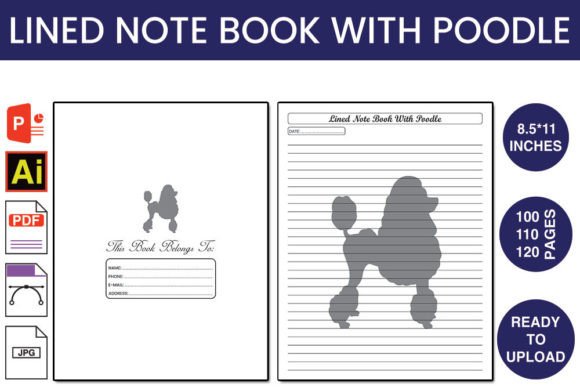
In the bustling world of Amazon KDP publishing, finding the right interior template can be the difference between a product that sells and one that languishes. The Lined Notebook with Poodle KDP Interior offers a charming, professional foundation specifically designed for the popular 8.5" x 11" trim size. But its true value isn't just in the cute poodle design or the clean lines; it lies in the complete package of source files—PDF, PPTX, AI, and INDD—that empower true customization. Many creators rush into publishing with a basic PDF, only to later realize they're locked into a design they can't adapt. Understanding what this product truly offers can save you time, money, and unlock your project's full potential.
The Common Pitfalls of Using Generic Notebook Interiors
When launching a notebook on KDP, the interior design is often treated as a secondary concern. A common mistake is choosing a template based solely on its immediate visual appeal, without considering the long-term flexibility you might need. For instance, you might find a lined notebook PDF that looks perfect, but if it's provided only as a final print-ready file, you're stuck. Want to change the line spacing, adjust the margins for better readability, or swap the poodle graphic for a cat to test a different niche? Without the original source files, you cannot. This limits your ability to iterate, respond to market feedback, or build a cohesive series of products.
Another overlooked detail is the page count specification. The Lined Notebook with Poodle KDP Interior comes in 100, 110, and 120-page variants. Choosing the wrong count isn't just about thickness; it affects perceived value and printing cost. A 100-page notebook might feel too slim for some customers, while 120 pages might push your printing costs slightly higher. Beginners often pick one arbitrarily, rather than comparing similar successful listings in their category to see what page counts are popular and commercially viable.
Why Source File Formats Matter More Than You Think
The inclusion of PowerPoint (PPTX), Illustrator (AI), and InDesign (INDD) files is the cornerstone of this product's utility. Each format serves a different type of user, and misunderstanding this can lead to frustration.
- PPTX (PowerPoint): Ideal for beginners or those without professional design software. It's intuitive for adjusting elements like the header, footer, or artwork placement. However, a mistake is trying to perform complex typography or precise layout changes in PowerPoint; it's simply not built for that.
- AI (Adobe Illustrator): This is key for modifying the vector artwork, like the poodle illustration. If you want to change the color, resize it, or replace it entirely with your own vector graphic, the AI file is essential. Trying to edit rasterized images from a PDF will result in a loss of quality.
- INDD (Adobe InDesign): This is the professional layout file. If you need to change the fundamental structure—like altering the page margins, line style, or master page elements—the INDD file is your control center. Attempting these changes by overlaying elements in another program often creates misaligned pages and a messy final PDF.
The practical advice here is to assess your own software skills and long-term plans before downloading. If you're a beginner, start with the PPTX file for simple tweaks. If you're a professional designer or plan to hire one, the INDD and AI files are invaluable. Not having access to these formats means any customization becomes a much more expensive and time-consuming rebuild.
Ensuring Quality and Avoiding Upload Issues
The product promises a high-quality, print-ready PDF. A critical step many skip is verifying this PDF against KDP's own technical requirements before upload. Even with a "ready" file, you should always check the page size (confirm it's exactly 8.5" x 11"), ensure there is no bleed (as specified), and preview every page for any hidden artifacts or misprints. A better approach is to use KDP's online previewer tool to simulate exactly how the interior will look as a printed book. This can reveal issues like lines being too faint or margins being too narrow that you might miss on a screen.
Furthermore, when using the source files for customization, a common error is not maintaining the same print-ready standards. For example, if you use the AI file to change the poodle graphic, you must re-export it at the correct resolution and re-integrate it into the layout. If you simply paste a low-resolution web image into the PowerPoint file, your final PDF will have a blurry, pixelated element that stands out poorly against the crisp lines, degrading the entire product's perceived quality.
A Realistic Customization Example
Imagine you purchase the Lined Notebook with Poodle KDP Interior and want to create a series: "Poodle Planner," "Poodle Journal," and "Poodle Sketchbook." With only a PDF, you'd have to create three completely different interiors from scratch. With the provided source files, your workflow becomes efficient. Using the INDD file, you can duplicate the master lined page layout. For the planner, you might add a date header using PowerPoint's simple text tools. For the sketchbook, you could use the Illustrator file to remove the poodle and replace it with a palette icon. This cohesive yet varied series becomes possible without redesigning the core structure each time, saving dozens of hours.
What to Check Before You Download and Use
Making an informed decision starts with a clear checklist. Before committing to the Lined Notebook with Poodle KDP Interior, ask yourself these questions:
- Do my customization plans match the provided file formats? If you need to change the core line design, you need InDesign. If you only need to change the title on the cover page, PowerPoint suffices.
- Have I confirmed the page count choice aligns with my target audience? Research other successful lined notebooks on KDP. Are bestsellers typically around 110 pages? Use that data.
- Am I comfortable with the software required? Ensure you have, or can access, Adobe Illustrator or InDesign if your plans require them. Don't assume you can "figure it out" in a program you don't own.
- Is the "No Bleed" specification correct for my product? Bleed is for full-color backgrounds that extend to the edge. For a simple lined interior with artwork confined to the page, no bleed is correct and simplifies the printing process.
By approaching this template as a flexible starting point—a toolkit rather than a finished, immutable product—you position yourself to create a notebook that truly reflects your brand and meets market demand. The Lined Notebook with Poodle KDP Interior, when understood and utilized fully, isn't just a pretty page layout; it's a strategic asset for any creator, entrepreneur, or publisher looking to build a quality product with the freedom to adapt and grow.