The Ledger Book: Your Strategic Hub for Financial Control and Business Growth
In the digital age, where financial data often feels ephemeral and scattered across screens, the tangible authority of a Ledger Book remains a cornerstone of sound business management. More than a simple record-keeping tool, a thoughtfully maintained Ledger Book serves as a strategic hub, providing clarity, control, and a concrete foundation for informed decision-making. For entrepreneurs, freelancers, and small business owners, it transforms raw numbers into a narrative of your venture’s health and trajectory.
Why a Ledger Book Is a Strategic Asset, Not Just a Record
Many business tools offer automation, but automation without understanding can lead to passive management. A Ledger Book demands active engagement. Writing down each transaction, categorizing expenses, and manually calculating balances forces a moment of reflection. This process creates a direct, tactile connection with your finances, fostering a deeper awareness of cash flow patterns, cost drivers, and profitability margins. It becomes a tool for strategic observation, not just archival.
The discipline of maintaining a Ledger Book cultivates financial mindfulness. It positions you to spot trends before they become problems, identify opportunities for cost optimization, and make funding decisions based on historical data rather than guesswork. This intentional approach turns the Ledger Book from a reactive log into a proactive planning instrument, directly supporting goals related to stability, growth, and operational efficiency.
Integrating the Ledger Book into Your Business Operations
The utility of a Ledger Book extends across the lifecycle of a business. For a new startup, it is the first formal system, establishing order from the outset. For an established entity, it can serve as a reliable parallel system to digital accounting, offering a quick-reference overview or a dedicated log for specific projects or cost centers. Its strategic value is unlocked by integrating it deliberately into your weekly or monthly review rhythms.
Establishing Clear Goals for Your Ledger System
Before opening a new Ledger Book, define its purpose. Is it the primary record for all business transactions? Is it tracking a specific marketing campaign budget or a new product line’s expenses? A Ledger Book used without a clear goal becomes a random collection of numbers. With a goal, it becomes a focused tool for measuring progress against a specific objective. This intentionality ensures every entry has context and contributes to a larger understanding.
Consider structuring your Ledger Book sections to mirror your business priorities. Separate pages for recurring operational costs, variable project expenses, and income streams can provide instant visual segmentation. This layout supports strategic analysis, allowing you to quickly assess which areas are consuming resources and which are generating returns.
Practical Application: From Daily Entries to Strategic Insights
The daily or weekly act of updating your Ledger Book is a tactical operation. Recording an invoice payment or a supply purchase is straightforward. The strategic power emerges in the monthly review. By summing columns, comparing periods, and calculating ratios like your expense-to-income percentage, you extract insights. For example, noticing a steady rise in a particular category of expense might trigger a strategic decision: to seek new suppliers, to renegotiate terms, or to evaluate if that cost is delivering commensurate value.
This Ledger Book analysis directly informs planning. If you see seasonal dips in cash flow, you can plan a reserve fund. If you see which clients or services are most profitable, you can strategically focus your efforts. The Ledger Book provides the evidence base for these decisions, grounding your strategy in factual financial history rather than intuition alone.
A Tangible Tool for Communication and Accountability
Beyond personal use, a well-organized Ledger Book can serve as a communication tool. For partnerships or small teams, a shared physical ledger can create transparency and collective accountability for budgets. In meetings, referring to the concrete pages of a Ledger Book can make financial discussions more accessible and grounded than abstract spreadsheet screens. It can also be an invaluable document for annual reviews, tax preparation, or applying for financing, providing a clear, chronological story of your business’s finances.
Risks and Considerations: Avoiding Passive Record-Keeping
The primary risk of using a Ledger Book is relegating it to a passive role. If entries are made hastily without review, or if the data is never analyzed, the Ledger Book becomes a historical artifact with no strategic value. The effort is wasted. To mitigate this, schedule regular, dedicated time for Ledger Book review—a financial “check-in” that is as important as any operational meeting.
Another consideration is complementarity. A Ledger Book is excellent for clarity and oversight, but for complex businesses with hundreds of transactions, it may need to be supported by digital tools for speed, reporting, and invoicing. The strategic approach is to use the Ledger Book for what it excels at: providing a master overview, fostering mindfulness, and serving as a reliable, offline backup. Define its scope to avoid duplication of effort or inconsistency with other systems.
Preparing for Long-Term Success with a Quality Ledger System
Choosing the right Ledger Book format is part of the strategic setup. A book with clear, spacious layouts, quality paper that withstands frequent use, and a durable binding supports long-term utility. The dimensions should suit your workspace, and the number of pages should align with your recording frequency to avoid needing a new book too soon or carrying a mostly empty one.
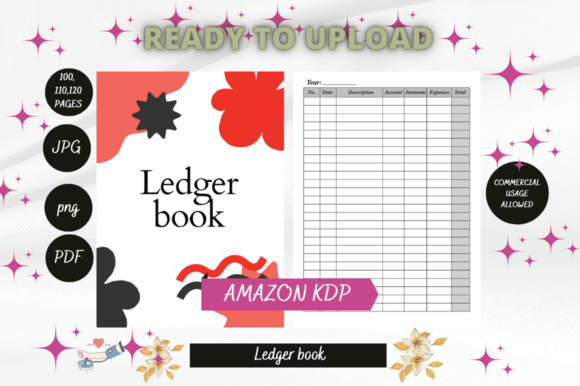
For those looking to implement or offer a professional Ledger Book system, ready-to-use templates are a significant asset. Having a tested, print-ready Ledger Book in PDF format, designed for dimensions like 8.5" x 11" with 100, 110, or 120 pages, removes the logistical hurdle. It allows you to focus immediately on the strategic practice of record-keeping rather than the design of the tool itself. Such ready-to-upload resources are particularly valuable for creators, publishers, and coaches who wish to provide clients with a turnkey solution for financial organization.
Turning Ledger Data into Strategic Action
The final, and most important, step is closing the loop between record-keeping and action. Your Ledger Book should not be an endpoint. The insights gleaned from it must feed into your business plans, budget adjustments, and growth strategies. Schedule a recurring task: after reviewing the Ledger Book, decide on one or two actionable changes. This might be cutting an unnecessary subscription, adjusting a pricing model, or allocating more funds to a high-performing area. This practice ensures the Ledger Book is a living, strategic engine for your business, continuously helping you make better decisions and achieve more sustainable results.
Ultimately, a Ledger Book is a testament to the principle that clarity precedes control. By providing a structured, tangible space to confront your financial reality, it empowers you to manage with intention. It supports not just the tracking of money, but the strategic stewardship of your business’s resources, paving the way for informed decisions, resilient operations, and deliberate growth.