Diamond-Shaped Mazes: The New Frontier in Puzzle Book Design and Cognitive Engagement
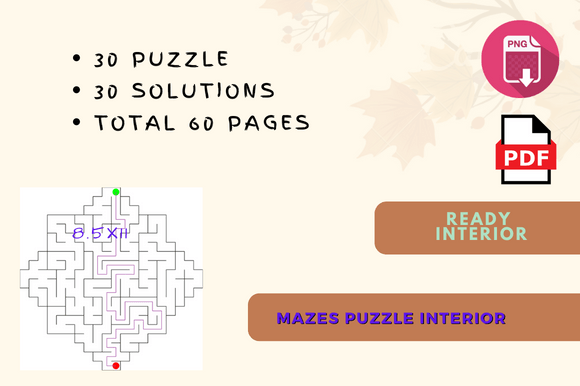
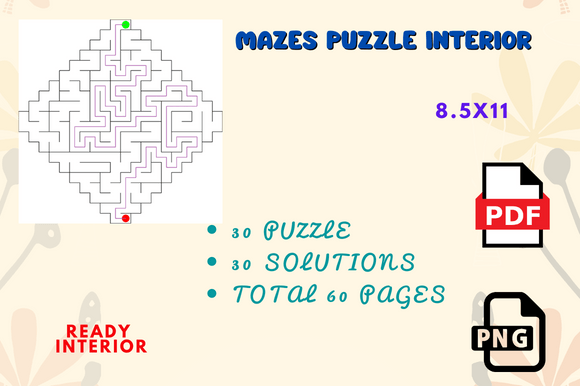
In the evolving landscape of independent publishing and creative content, the tools and templates available to creators are undergoing a subtle but significant transformation. The demand is shifting from generic, readily available assets to specialized, thoughtfully designed interior layouts that offer both aesthetic distinction and functional value. The Mond Maze 30 Puzzles INTERIOR represents a precise response to this shift, moving beyond the standard square grid to introduce a collection of 30 exclusively diamond-shaped mazes with solutions, packaged as a KDP-ready PDF. This isn't merely a puzzle book template; it's a curated design product tailored to a market that increasingly values novelty, cognitive challenge, and professional presentation.
The Anatomy of a Specialized KDP Interior
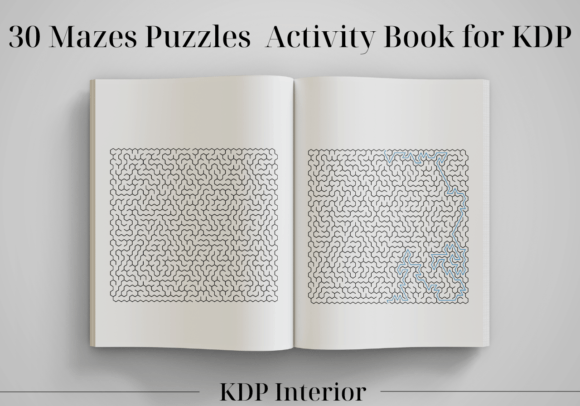
Understanding the Mond Maze 30 Puzzles INTERIOR begins with its specifications: a 60-page PDF formatted for 8.5"x11", featuring one unique diamond-shaped maze per page followed by its corresponding solution. This structure is deliberate. The single-maze-per-page format eliminates clutter and distraction, focusing the solver's attention entirely on the singular geometric challenge presented. The inclusion of immediate solutions respects the modern user's expectation for accessibility and closure, a key consideration in educational and recreational products today. The diamond shape itself is the core innovation, departing from traditional labyrinth designs to offer a puzzle that starts from a central point or edge and radiates outward, fundamentally altering the pathfinding logic and visual engagement.
Where Design Meets Cognitive Science
The choice of a diamond shape is not arbitrary. From a design perspective, it breaks the monotony of rectangular puzzle books, offering a visually striking product that stands out in a crowded marketplace. More profoundly, it engages the solver's brain differently. A diamond maze often introduces multiple potential starting trajectories and requires navigation through angled pathways, which can challenge spatial reasoning and pattern recognition in ways that conventional mazes do not. This aligns with broader trends in "brain training" and mindful leisure activities, where consumers seek out varied cognitive stimuli that are both entertaining and potentially beneficial for mental acuity.
Integration into Creator Economies and Market Trends
The rise of platforms like Amazon KDP has democratized publishing, but it has also intensified competition. Success now hinges on niche specialization and product quality. The Mond Maze 30 Puzzles INTERIOR fits directly into this ecosystem by providing creators—authors, designers, educators—with a ready-to-upload, professionally formatted product. It eliminates the substantial time investment required to design 30 unique, complex mazes and their solution keys, a task that would demand considerable expertise in graphic design and puzzle logic. This allows entrepreneurs and freelancers to rapidly deploy a high-quality puzzle book, focusing their efforts on marketing and brand building rather than asset creation.
This template also responds to observable consumer trends. The market for puzzle books has expanded beyond children's activities to include adults seeking stress-relief, focused downtime, and non-digital entertainment. The adult coloring book phenomenon paved the way, demonstrating a strong demand for structured, creative, analog activities. Diamond-shaped mazes, with their elegant and challenging form, cater to this same audience looking for a more sophisticated, engaging puzzle experience. They offer a tactile, screen-free alternative that is both aesthetically pleasing and mentally stimulating.
Practical Applications and Audience Reach
The utility of this specialized interior extends across several professional domains. For educators, it can serve as a resource for developing spatial reasoning skills in students, offering a fresh format for classroom activities or supplementary materials. For marketers and brands, a custom puzzle book using such a distinctive layout can be an innovative promotional tool or corporate gift, associating the brand with qualities of intelligence and design. For the lifestyle entrepreneur, publishing a book of diamond mazes taps into the wellness and self-improvement market, positioning puzzles as a form of mindful practice.
A key observation is the workflow efficiency it enables. A creator can upload the provided PDF directly to KDP, immediately having a product with 30 unique puzzles and 30 clear solutions—a complete package. This addresses the changing expectation of solo entrepreneurs and small studios: access to turnkey, premium-grade assets that allow them to compete with larger publishers without requiring a large production team.
The Relevance of Geometric Variation in Creative Content
The move towards shapes like the diamond reflects a larger development in content creation: the pursuit of geometric and structural variation to sustain interest. In digital games, app design, and even physical products, variety in form is a known engagement driver. Applying this principle to puzzle books is a logical evolution. It signifies that the category is maturing, moving from commoditized grids to designed experiences. The Mond Maze 30 Puzzles INTERIOR is essentially a deliverable of this evolution, providing the tangible asset that embodies the trend.
Furthermore, in a world saturated with standardized digital interfaces, analog items with distinctive physical or visual properties gain value. A book filled with diamond-shaped puzzles has an inherent novelty factor. It feels different, it looks different, and it challenges the user differently. This aligns with consumer preferences for products that offer not just utility, but a unique character and experience—a principle central to the success of many modern indie brands and creator-led projects.
Forward-Looking Implications for Puzzle Design
The specialization seen in this product points to a future where puzzle book interiors will become increasingly categorized by shape, difficulty gradient, thematic artwork, and cognitive target. We might see interiors dedicated to hexagonal mazes, wave-shaped paths, or puzzles integrated with specific narratives. The technology of PDF creation and on-demand printing, facilitated by platforms like KDP, makes this specialization economically feasible. A creator can now target a very specific segment—say, adults interested in geometric art and logic puzzles—with a professionally crafted product, without the overhead of mass-market distribution.
The Mond Maze 30 Puzzles INTERIOR, therefore, is more than a file; it is a case study in how digital tools and changing market demands converge to enable hyper-specialized content. It showcases how a simple shift in form—from square to diamond—can redefine a product's market position, user engagement, and relevance to contemporary trends in leisure, education, and independent business. For the professional looking to publish, the enthusiast seeking a new challenge, or the marketer observing content trends, it represents a clear, practical example of innovation within a classic format, built ready for the modern marketplace.