A Diabetes Food Blood Sugar Tracker for Creative Work
Imagine holding a physical tool that transforms complex health management into an elegantly organized visual journey.
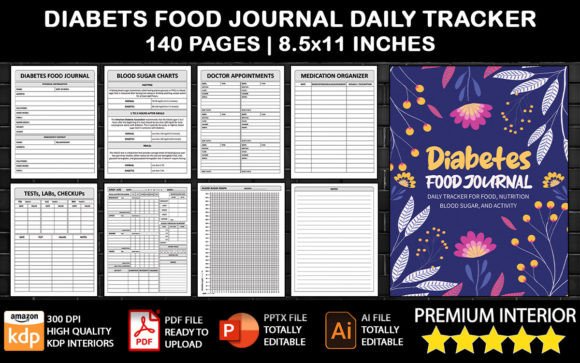
This is the core value of a professional Diabetes Food Blood Sugar Tracker, a product whose success hinges on its graphic design and visual clarity. From a designer's perspective, creating such a tracker is not merely about layout; it's an exercise in functional editorial design, where typography, color palette, and visual hierarchy must work in harmony to guide the user effortlessly. The editable version for KDP interiors represents a complete creative asset pack, ready for implementation by other creators, embodying principles of modern aesthetics and professional presentation.
Designing for Clarity and Usability
At its heart, an effective tracker is a UX design project for print. Every element—from the daily log grids to the 30-day challenge tracker—must be intuitively organized. Clear visual hierarchy ensures the user can immediately locate the meal planner or doctor visit notes without confusion. This demands a thoughtful approach to spacing, font weights, and section demarcation. The use of a consistent color palette, often employing CMYK-optimized colors for print, can gently code different sections, aiding navigation while maintaining a calm, professional feel crucial for a health-related journal.
The Role of Typography and Layout
Typography is the silent guide. Selecting fonts that are highly readable at various sizes, even within condensed tables for blood sugar readings, is paramount. A blend of a clean sans-serif for data entry and a slightly more stylistic serif for section headers can establish a subtle brand identity within the product itself. The 10 different templates included in such a pack offer variety, but they must all share a cohesive underlying grid structure and typographic system to feel part of a unified design workflow, not a disjointed collection.
Consider the practical applications of this design philosophy beyond the page:
- Branding Extension: The visual style of the tracker can inspire complementary digital assets, like app UI design or social media graphics for health communities.
- Marketing Materials: Clean templates serve as a foundation for promotional leaflets or website banners advertising the tracker.
- Digital Product Creation: The editable source files allow designers to adapt layouts for other digital logbooks or printable planners, expanding their creative projects.
A Complete Creative Asset for Production
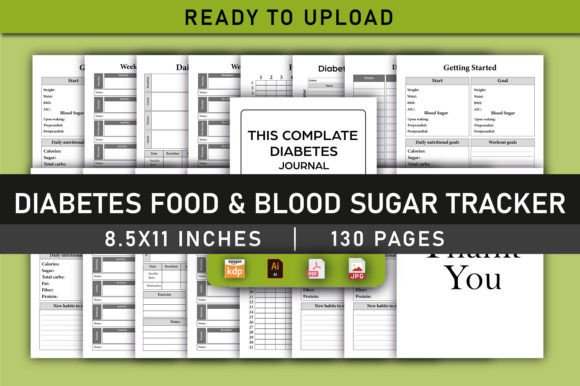
The specification of 130 pages, 300 DPI, and no bleed speaks directly to print design precision. Providing a high-quality print-ready PDF alongside JPG source files caters to different creator needs—one for immediate upload to Amazon KDP, the other for further customization. This dual offering reflects an understanding of the modern creator's ecosystem, where flexibility is key. The included sections like habit trackers and weekly workout planners demonstrate how editorial design can integrate diverse data types into a single, visually coherent system.
When evaluating or using such a template pack, focus on these design-centric factors:
- Scalability: Are the design elements crisp and non-pixelated at full size? The 300 DPI guarantee addresses this.
- Consistency: Does the color and typography system hold across all 10 templates, creating a professional identity?
- Audience Alignment: Does the modern aesthetic feel appropriate and engaging for users managing their health?
- Functional Composition: Is space allocated logically, balancing data density with visual calm?
Ultimately, a well-designed Diabetes Food Blood Sugar Tracker transcends its primary function. It becomes a case study in how thoughtful graphic design—through meticulous attention to typography, color, and layout—can elevate a practical tool into an object that supports not just health management, but also user engagement and peace of mind. The availability of such a polished, ready-to-use creative asset empowers other designers and entrepreneurs to deliver quality without starting from a blank page, proving that in design, as in health, a strong foundation is everything.