The Strategic Value of 50 Sudoku Easy Puzzles with Solutions
In a world demanding constant cognitive engagement, a structured resource like 50 Sudoku Easy Puzzles with Solutions offers more than simple entertainment. It represents a curated toolkit for mental clarity, a deliberate practice ground for focus, and a surprisingly potent analog for strategic thinking. For professionals, creators, and decision-makers, engaging with this collection is not merely about filling grids; it's about honing the disciplined approach to problem-solving that underpins success in complex environments.
Beyond the Puzzle: A Framework for Disciplined Thinking
At its core, the act of solving a Sudoku puzzle is a linear process of deduction, pattern recognition, and constraint management. Each puzzle within a collection of 50 Sudoku Easy Puzzles with Solutions presents a bounded system with clear rules and a single optimal outcome. This mirrors many professional challenges: a project with defined parameters, a marketing campaign with specific goals, or an operational process needing optimization. Regularly working through these puzzles trains the mind to methodically eliminate possibilities, validate assumptions against established rules, and proceed step-by-step toward a complete solution. This mental muscle, developed in a low-stakes environment, becomes transferable to higher-stakes scenarios where clear, logical progression is key.
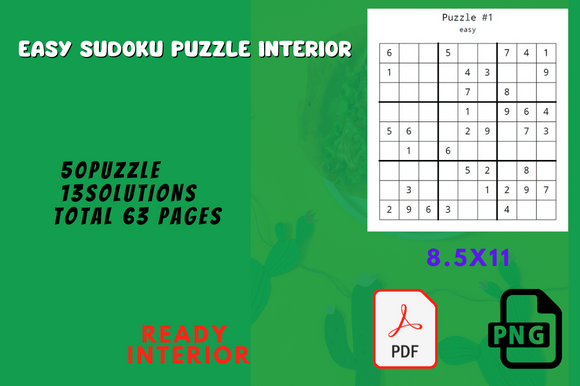
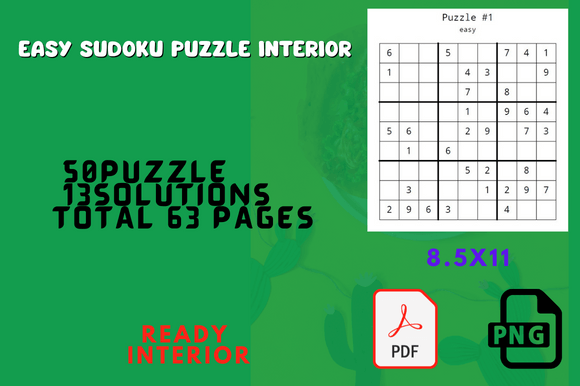
Consider the KDP Interior ready-to-upload format—a single PDF file of 63 pages designed for 8.5"x11" printing. This practicality itself is strategic. It removes friction. For an entrepreneur looking to offer a digital product or a educator seeking a structured activity, this ready-made resource eliminates the time cost of creation and formatting. The decision to use it becomes one of allocation: investing time in strategic application rather than in administrative assembly. The included solutions further underscore this. They are not just answers; they are validation tools and learning aids. Checking a solution reinforces correct deductive pathways, solidifying the effective methodology.
Intentional Use for Cognitive Maintenance and Creative Breaks
The strategic use of 50 Sudoku Easy Puzzles with Solutions lies in its intentional application, not random consumption. For the busy professional, scheduling a short daily session with one puzzle can serve as a cognitive reset. It forces a shift from open-ended, often stressful tasks to a closed-system problem with a guaranteed solution. This transition can clear mental clutter, similar to the effect of a meditative practice, and often leads to renewed focus on primary work. The "easy" designation is crucial here; it ensures the activity is accessible and relaxing, not a source of additional frustration. This makes it a sustainable tool for mental maintenance.
For roles demanding creativity—marketers, writers, designers—this puzzle book can act as a catalyst for divergent thinking. The logical, structured task engages a different part of the brain than creative ideation. Switching to this mode for 10-15 minutes can often break through creative blocks, allowing the mind to subconsciously reorganize ideas before returning to the main project with fresh perspective. The completion of each puzzle provides a small, concrete win, boosting morale and momentum that can carry over into more ambiguous creative tasks.
Planning and Operational Analogies
Each Sudoku grid is a miniature model of resource allocation and space management. Numbers 1 through 9 must be placed correctly without conflict in rows, columns, and sub-grids. This is a direct analogy for planning: placing tasks in a schedule (rows/columns) without overloading specific days or time blocks (sub-grids). Engaging with 50 Sudoku Easy Puzzles with Solutions can subtly reinforce the importance of systemic harmony and the consequences of misplaced elements. For an individual planning a product launch or a manager allocating team resources, the puzzle-solving mindset—looking at the whole system while making local decisions—becomes an ingrained habit.
The inclusion of solutions encourages a healthy review process. After completing a puzzle, one can compare their path to the provided solution. This is akin to a post-project review or a operational audit: comparing your executed process to an optimal model to identify deviations and learn from them. This reflective practice, built into the use of the puzzle book, promotes continuous improvement in one's problem-solving approach.
Risks of Uncontextualized Use and Strategic Mitigation
While the resource is valuable, using 50 Sudoku Easy Puzzles with Solutions without clear intent carries minimal risks, chiefly of time misallocation. The primary risk is viewing it purely as a passive diversion, thereby missing its strategic training potential. It could become a procrastination tool if used to avoid more pressing, albeit more difficult, tasks. The mitigation is simple: deliberate scheduling. Treat the puzzle session as a defined mental workout with a time limit. Anchor its use to a specific goal: "15 minutes to reset focus before drafting the proposal," or "one puzzle after lunch to transition back into analytical work."
Another consideration is over-reliance on the solutions. While they are essential for learning and verification, the strategic habit is to attempt the puzzle independently first, embracing the struggle of deduction. The solution is a reference, not a shortcut. This mirrors a business principle: develop your own strategic plan before seeking external templates or benchmarks. The value is in the process, not just the outcome.
Long-Term Value and Skill Transfer
The cumulative effect of engaging with the entire collection of 50 Sudoku Easy Puzzles with Solutions is the gradual, unconscious strengthening of core cognitive skills. Pattern recognition speeds up. The ability to hold multiple constraints in mind simultaneously improves. Patience for incremental progress is nurtured. These are not flashy skills, but they are foundational for effective decision-making, clean communication (which requires logical structure), and meticulous operational management. For the freelancer managing multiple clients or the small business owner overseeing various facets of their company, these refined mental habits contribute directly to reduced error, clearer planning, and calmer management of complexity.
Furthermore, the physical format—the KDP Interior with one puzzle per page—encourages a ritual of completion. Each page turned represents a finished task. This tactile progress can be psychologically reinforcing, modeling the importance of completing discrete units of work within a larger project. It’s a subtle lesson in productivity: large goals are achieved by systematically completing well-defined, smaller components.
Integrating 50 Sudoku Easy Puzzles with Solutions into a Professional Routine
To extract maximum strategic value, integrate this resource intentionally. Do not simply open the PDF when bored. Instead, designate it as a tool for specific scenarios. Use it as a warm-up exercise before deep analytical work. Employ it as a buffer activity between different types of tasks to cleanly switch cognitive modes. Utilize it as a shared activity in team settings to informally encourage collaborative logical thinking. For educators, it can be a classroom tool for teaching logical reasoning and patience. For content creators, it can be the basis of a branded product that aligns with themes of mental agility and smart leisure.
The ultimate strategic takeaway is that 50 Sudoku Easy Puzzles with Solutions is more than a puzzle book. It is a formatted experience designed to train a methodical, constraint-aware, and pattern-driven mindset. When used with purpose, it becomes a low-cost, high-return investment in the cognitive habits that underpin strategic success in nearly any field. The puzzles are easy, but the benefits, when leveraged thoughtfully, are profoundly deep.